Intelligent Decision Making Reasoning
Researching how confidence, persistence, context and operational rules can transform raw AI detections into meaningful events.

Researching how confidence, persistence, context and operational rules can transform raw AI detections into meaningful events.
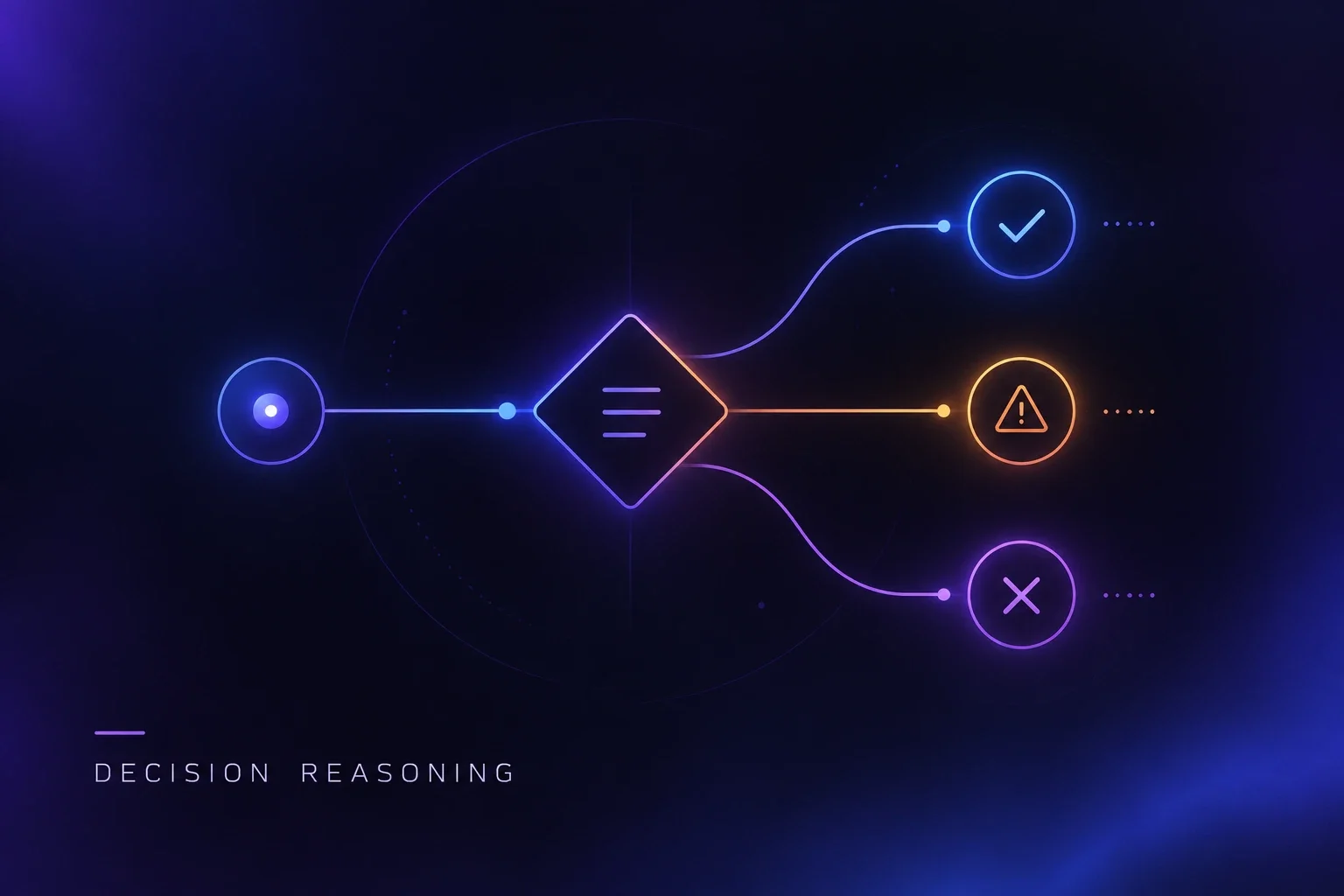
A detection model can be highly sensitive and still produce outputs that are not operationally useful.
Real environments contain reflections, weather effects, short-lived visual patterns, partial occlusion and many other sources of ambiguity. A practical system needs a way to determine which detections deserve attention.
Our work on Intelligent Decision-Making Reasoning explores that layer between model output and operational event.
The reasoning process evaluates several signals together rather than relying on one confidence score.
Examples include:
The goal is to create a decision mechanism that can be adapted per camera, per environment and per use case.
A conceptual rule could be expressed as:
IF
  probability > threshold
  AND persistence > minimum_duration
  AND visual_area > minimum_area
  AND zone_type = relevant
THEN
  create_validated_event
Real systems can combine several such conditions, including rules that reduce confidence, defer a decision or request more evidence.
A high model score is useful, but it should not automatically imply that an operational event exists.
Events that remain visible across time can be treated differently from isolated detections.
The same detection may have a different meaning depending on the camera, location or operational zone.
Different customers and environments may require different levels of sensitivity, confirmation and escalation.
Reasoning should improve usefulness without making the system opaque or too rigid.
Key questions include:
Decision reasoning is one of the mechanisms that can connect visual models with real operational workflows.
It is relevant to environmental monitoring, safety, security conditions and other applications where the cost of either a false alert or a missed event is meaningful.