Edge & Heterogeneous Computing
Exploring how visual workloads can be distributed across cameras, edge devices and accelerated compute for efficient deployment.

Exploring how visual workloads can be distributed across cameras, edge devices and accelerated compute for efficient deployment.
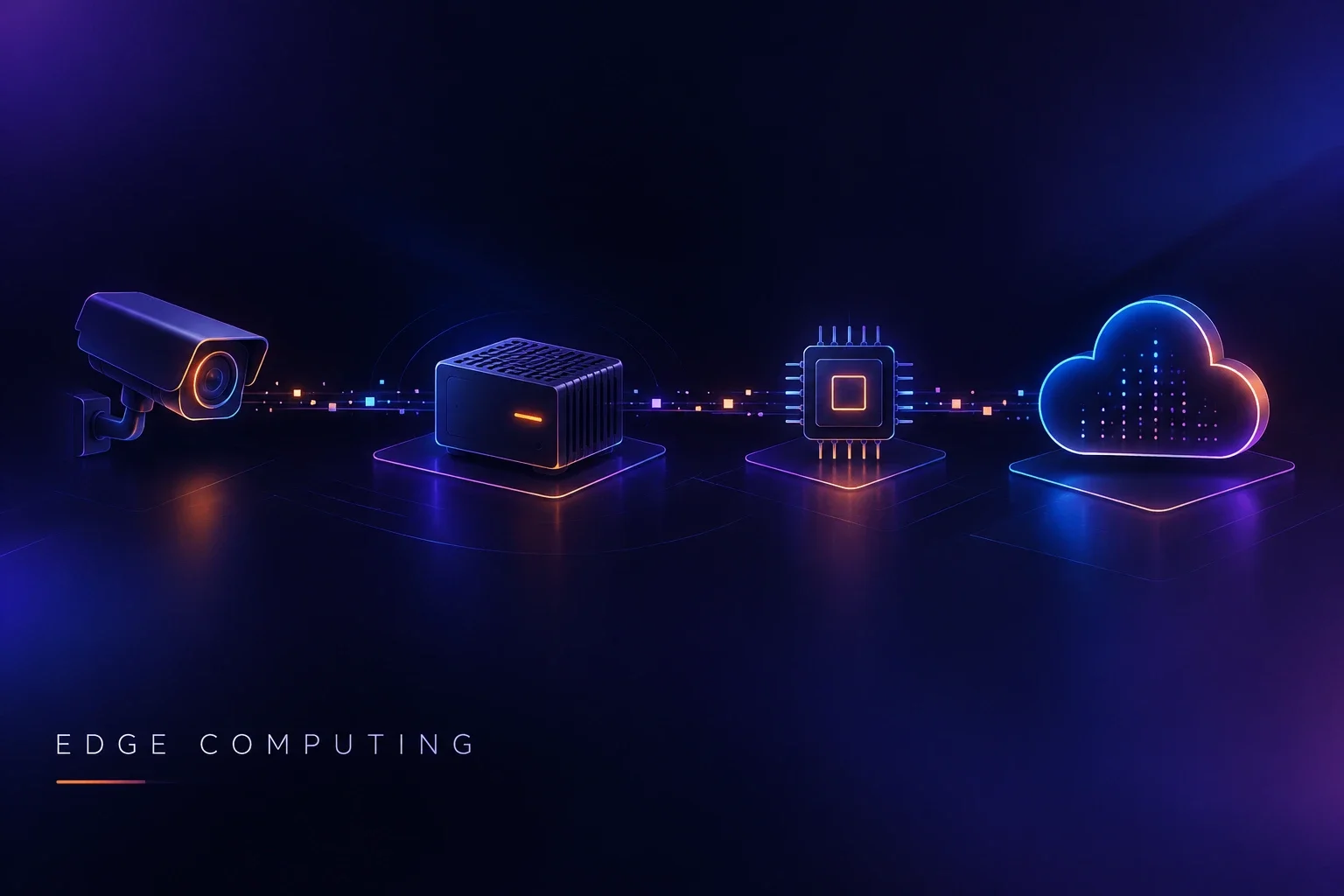
There is no single ideal place to run every computer-vision workload.
Some tasks benefit from running inside a camera. Others require an edge computer with a CPU, GPU or specialised accelerator. Some workloads may still benefit from cloud resources.
Our research explores how to decide where each part of a visual pipeline should execute.
A visual application can potentially use several computing layers:
Camera → Local edge device → Accelerated edge → Remote infrastructure
Each layer has different advantages.
| Location | Typical strengths |
|---|---|
| Camera | Minimal bandwidth, immediate local processing |
| Edge CPU | Flexible local control and integration |
| Edge GPU / accelerator | Higher AI performance close to the source |
| Remote compute | Elastic resources and centralised heavy workloads |
The decision is rarely based on performance alone.
Important factors include:
Future deployments may contain different combinations of CPUs, GPUs, NPUs and camera-integrated processors.
A flexible vision architecture should be able to assign workloads to the most appropriate compute resource instead of assuming one hardware profile everywhere.
This research contributes directly to our goal of making advanced visual intelligence practical across very different real-world environments.