Reusable Vision Models
Exploring model foundations that can be adapted across applications instead of rebuilding vision intelligence for every new use case.

Exploring model foundations that can be adapted across applications instead of rebuilding vision intelligence for every new use case.
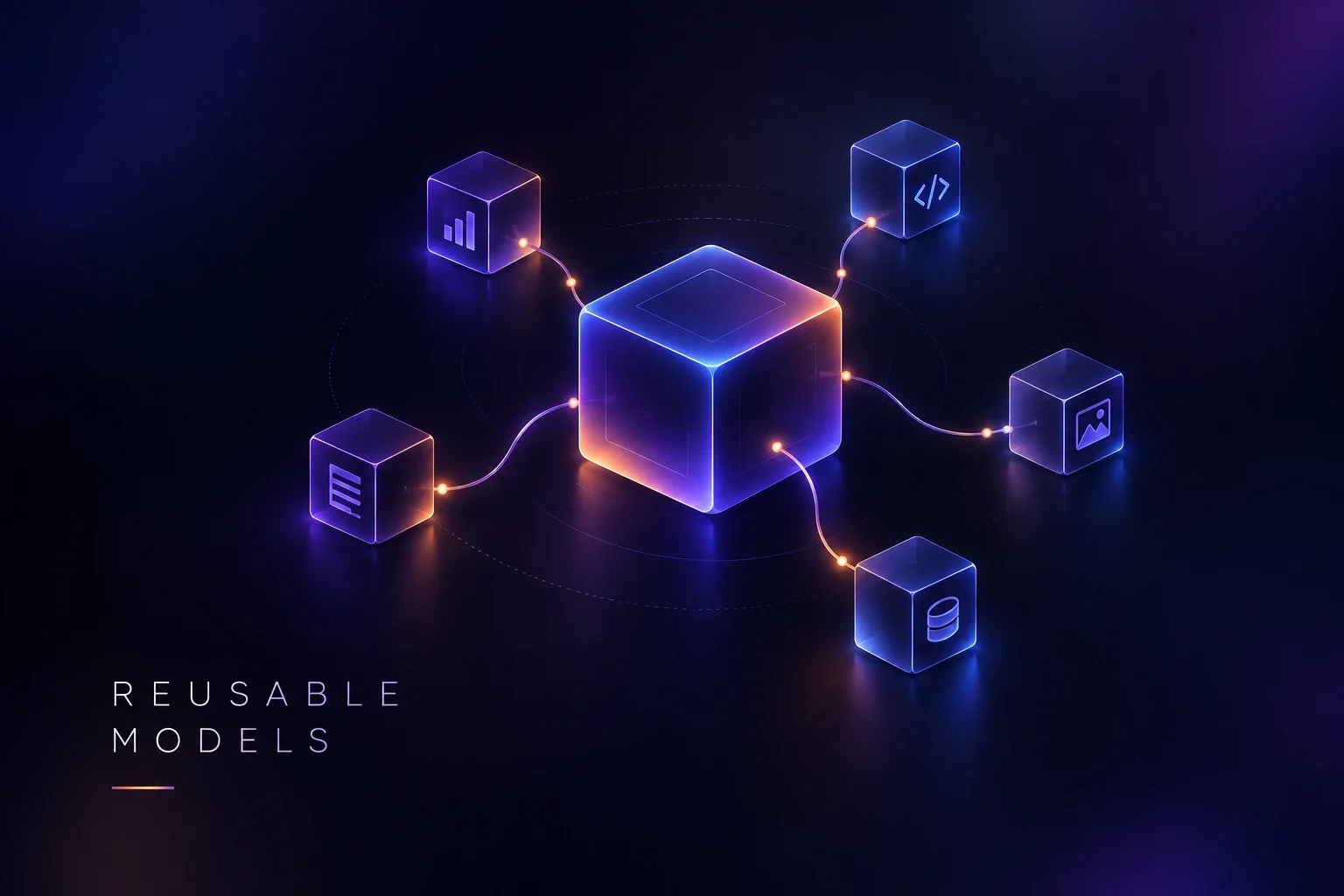
Computer-vision solutions are often developed as isolated projects: one dataset, one model, one problem.
That approach can work, but it makes expansion slow and expensive. Every new application may require new training, new infrastructure and a new integration path.
Our research explores how shared visual foundations can be reused and adapted across multiple applications.
Instead of treating every vision task as independent, we are interested in architectures with a common visual foundation and specialised adaptation layers.
Conceptually:
Shared visual foundation → task-specific adaptation → application logic
Possible adaptation mechanisms include:
Can one model learn representations that remain useful across several operational domains?
How much application-specific training is required to adapt a common model to a new task?
When is it better to maintain one general model versus a family of related specialised models?
Reuse can also happen above the model layer, through shared reasoning, event schemas and deployment patterns.
A reusable model strategy can potentially improve:
It also aligns with the broader OCCIVUE direction of enabling new visual solutions to be assembled from modular capabilities.
Reusable models must balance breadth with precision.
A model that is too general may underperform a dedicated specialist model. A model that is too specialised loses the advantages of reuse.
Our research therefore focuses on finding practical trade-offs between generality, accuracy, adaptation cost and inference efficiency.